
Despite 14 budgets we are still around 4500 levels since 1992

Finance Minister Nirmala Sitharaman on Saturday said the new tax regime will benefit the middle class as it will leave more money in their hands. Talking to reporters after the customary post-Budget address to the central board of the RBI, she said it is not necessary to induce individuals to invest through government schemes but give them an opportunity to make a personal decision regarding investments. "...the way we allowed for standard deduction and also the rates which have been fixed, tax rates which have been fixed for different slabs, it has actually left more money in the hands of the people, the taxpayer, the household," she said.

Economy to grow by 7.2-7.5 per cent in second half of current fiscal, says FM.

There is no direct impact of the Russia-Ukraine crisis on India in terms of bilateral trade but a surge in oil prices poses considerable risk to the economy, an analyst report said on Friday. International oil prices which have surged past $100 per barrel "pose risks to external stability and currency movement," a Bank of Baroda Economics Research report said. Russia has launched military operations against Ukraine, stoking fears of significant disruption in the region, including loss of life. The West is ramping up financial sanctions against Russia and support for Ukraine.

The industry's reactions to the Budget have been mixed.

Oil prices have already fallen over 70 per cent since the downturn began in mid-2014.

This means lower losses on fuel sales by Indian oil companies and a shrinking oil subsidy bill for the government.

If you looked back at 2018 and had to give it a name, the Year of Limitations might be the most accurate.

The Budget sets out a comprehensive vision.

'The term 'pro-growth' must be qualified somewhat because, while a rising tide will lift all boats, it will not necessarily do so equally.'

Financials were the top losers while oil shares also declined amid weak crude oil prices.
.jpg)
The economy grew at a four year low of 4.4 per cent in the April-June quarter of current year.

Amid a grim global scenario, India will have to labour hard to hold on to seven per cent growth in 2016-17.

Increase in tax exemption limit by Rs 50000 is positive for the FMCG sector, as it will leave more discretionary income in the hands of consumers.
The industry said if the policy was announced, it would have taken 28 million vehicles bought before March 2005 off the road.

Most expect the Budget to be path-breaking.

Govt wants to up investment in Railways
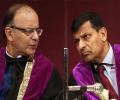
In cutting interest rates and giving a boost to the government's efforts to revive growth, RBI governor Raghuram Rajan displayed the pragmatism and flexibility familiar to those who work with him.

Shreekant Sambrani remembers P R S 'Biki' Oberoi, personal friend and hospitality icon, who passed into the ages this week.

India's gross tax collections soared to a record high of Rs 27.07 lakh crore in the fiscal year ended March 31, led by impressive growth in corporate tax and customs, taking the tax-to-GDP ratio to an over two-decade high of 11.7 per cent, Revenue Secretary Tarun Bajaj said on Friday.

More incentives will be given to agriculture sector for increasing agriculture production.

While the corporate sector has benefited from massive capital expenditure, leading to sky-rocketing stock prices, investors would do well to keep an eye on the macroeconomic picture and government finances, not just corporate profits, for signs of trouble, alerts Debashis Basu.

'India's output contraction in the previous year was among the worst in the world!'

President Ranil Wickremesinghe on Wednesday thanked India and Prime Minister Narendra Modi for giving Sri Lanka 'a breath of life' by providing timely economic assistance to his country as it faced the worst economic crisis in decades.

'The signal is crude oil prices will rise, I am cutting my subsidy. Be prepared, prices will rise.'

'Higher than expected inflation in the US or the European Union, faster than expected tightening by the major central banks, break out of a war in Europe, and withdrawal of portfolio equities from the emerging markets are factors which can result in equity market corrections.'

Opposition said saying it lacked vision and road map to execute ideas.

When oil prices are very high, cutting down the subsidy results in sharp increase in oil prices.

Finance minister Nirmala Sitharaman on Wednesday exuded confidence that inflation would further decline and the government is on track to meet its budgetary target for deficit and said that there is no fear of stagflation in India. Replying to the debate on first batch of Supplementary Demands for Grants 2022-23 in Lok Sabha, the finance minister said inflation has come down and it is now in the tolerable band of the RBI. Inflation has been declining since April 2022 and it is declining further, she said.

Moody's Investors Service on Thursday slashed India's economic growth projection to 8.8 per cent for 2022 from 9.1 per cent earlier, citing high inflation. In its update to Global Macro Outlook 2022-23, Moody's said high-frequency data suggests that the growth momentum from December quarter 2021 carried through into the first four months this year. However, the rise in crude oil, food and fertilizer prices will weigh on household finances and spending in the months ahead.
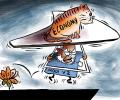
India's growth outlook has weakened sharply this year, with a crunch that started with the non-banking finance institutions spreading to retail businesses, car-makers, home sales and heavy industries.

Equity markets will look for directions from global trends, ongoing quarterly earnings and investment patterns of foreign institutional investors (FIIs) in a holiday-shortened week ahead and may encounter volatility amid the scheduled monthly derivatives expiry, according to analysts. Equity markets will remain closed on Wednesday on account of 'Republic Day'. "This week is a holiday-shortened one and it's going to be critical due to the list of events and data that are lined up.
India's inflation trajectory in the coming months will be influenced more by the geo-political situation due to the war in Europe and its impact on supply chains and commodity prices. However, the country is better placed than most to "weather the storm" and achieve growth of close to 8 per cent in the current fiscal year, the finance ministry said in its latest monthly economic report on Thursday. "Through the channel of imports, elevated global crude and edible oil prices now have a significant impact on India's inflation outlook. "Government measures to keep the prices of these commodities in check, along with the recent hike in policy rates by the RBI, are expected to temper inflationary pressures in the economy," the monthly economic report for April, drafted by the finance ministry's economic division, said.

The central government is on track to meet its fiscal deficit target of 6.4 per cent of the GDP for 2022-23 on the back of strong growth in revenue collections, the World Bank said in its India Development Update on Tuesday. High nominal GDP growth in the first quarter supported strong growth in revenue collection, especially Goods and Services Tax (GST), despite tax cuts on fuel. Notwithstanding an increase in spending due to expanded fertilizer subsidies and food subsidies for vulnerable households in response to the commodity price shock, the government is on track to meet its FY22/23 fiscal deficit target of 6.4 per cent of GDP and the general government deficit is projected to decline to 9.6 per cent from 10.3 per cent in FY21/22 and 13.3 per cent in FY20/21.
Surplus in March, the last month of a financial year, has helped the government reduce fiscal deficit in the last few years.
The Monetary Policy Committee (MPC) may go for a hike of up to 0.25 per cent in the reverse repo rate at which the RBI absorbs excess liquidity and leave the repo rate at which it lends, to narrow the policy rate corridor, a British brokerage said on Thursday. "Growth concerns amid spread of the Omicron variant and relatively benign inflation out-turns provide the RBI with enough room to maintain its growth-supportive monetary policies," analysts at Barclays said, ahead of the resolution announcement next week. The RBI will hike the reverse repo rate by 0.20-0.25 per cent, given its liquidity management actions, it said.

India is set for decent growth in 2015.

The upcoming Budget gives Finance Minister Arun Jaitley a chance to let states boost spending.

The Reserve Bank's growth projection for next financial year is lower than 8-8.5 per cent projected by the finance ministry in the recent Economic Survey which was tabled in Parliament on January 31. Unveiling the bi-monthly policy, RBI governor Shaktikanta Das said, "Recovery in domestic economic activity is yet to be broad-based, as private consumption and contact-intensive services remain below pre-pandemic levels."

Though India has been one of the best-performing markets in the last two months, it has lagged some of its emerging market peers such as the Philippines, Thailand and South Africa.
